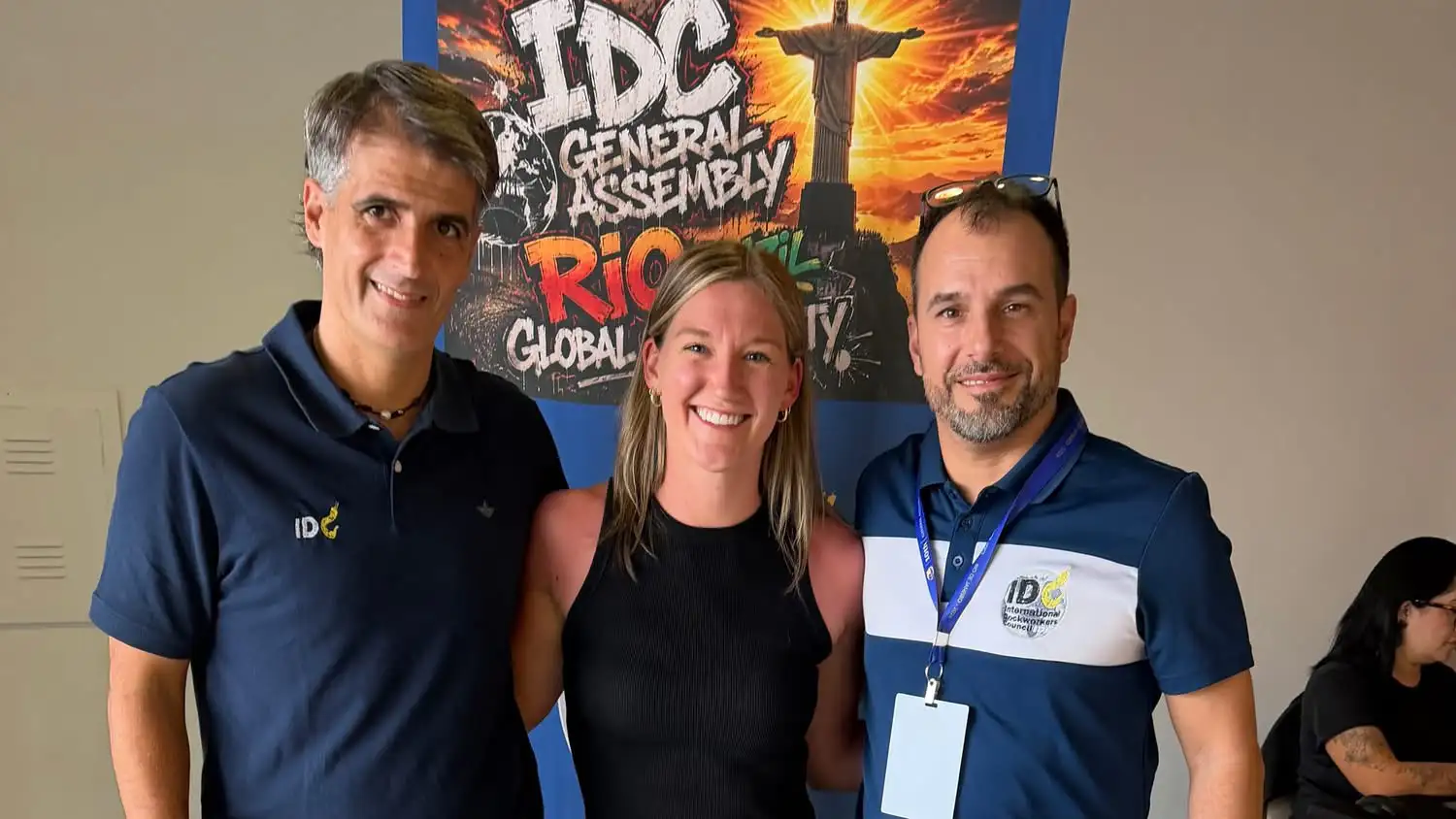

RIO DE JANEIRO, BRAZIL (November 18, 2026) The 10th General Assembly of the International Dockworkers Council (IDC) began this week in Rio de Janeiro, Brazil, following historic organization growth, quadrupling its membership base since 2019 to unite 108 dockers unions across 39 countries.
The summit establishes the 2026-2030 Strategic Vision, demanding binding collective bargaining prior to any technological deployment in marine terminals and halting so-called “automation by erosion.”
Harold J. Daggett, International President of the International Longshoremen’s Association, and the architect of the strongest anti-automation collective bargaining agreement will deliver an address during the assembly that is expected to rally all global dockworkers to follow his lead and demand full and complete protection against automation.
The IDC 10th General Assembly marks a turning point for the global maritime and port industry, bringing together delegations from five continents representing more than 220,000 port workers united under 108 trade union organizations across 39 countries.
Organized in collaboration with Brazil’s three major port labor federations—FNE, FNP, and FENCCOVIB—the gathering in Rio de Janeiro consolidates the largest expansion cycle in the IDC’s 26-year history. Since its previous General Assembly in New Orleans in 2022, when membership stood at 130,000, the organization has grown by more than 69%, more than quadrupling the 50,000 members it recorded in 2019.
“We are not simply gathering for another conference; we are meeting in Rio to confront the challenges before us and determine the future of dockworkers around the world,” states Dennis A. Daggett, IDC General Coordinator and the ILA’s International Executive Vice President. “The employers and multinational corporations operating in our industry do not recognize borders when pursuing their interests, and neither can we when defending ours. Capital is global, and our solidarity must be global as well.”
A Common Front Against AI and “Automation by Erosion”
The core focus of the plenary sessions—which will take place on November 18 and 19 at the Rio Othon Palace Hotel in Copacabana—will be the impact of terminal automation, artificial intelligence (AI), 5G networks, and Terminal Operating Systems (TOS) on employment and collective bargaining.
Following recent milestones such as the historic three-day strike led by the ILA across the entire US East and Gulf Coasts to shield collective agreements against robotics, as well as the Maritime Alliance forged at the Lisbon Summit in November 2025 alongside delegates from more than 60 countries, the IDC will approve a global roadmap in Brazil for the 2026–2030 period.
“We are not opposed to progress, modernization, or technology that makes our workplaces safer and more productive; however, we will never accept the argument that progress must come at the expense of the men and women whose labor built this industry. Modernization should improve the lives of workers, not destroy their livelihoods,” emphasizes Daggett, sending a direct message to major shipping lines and global operators: “You may control the ships, own the terminals, and possess the technology, but never underestimate the collective strength of those who keep the world’s commerce moving.”
For his part, Jordi Aragunde, IDC International Labor Coordinator, will present the 2022–2026 management report and the Strategic Vision to 2030, focused on establishing minimum global standards for labor protection, training, and safety across collective bargaining agreements.
“If a multinational wishes to introduce technology, it has an obligation to sit down and negotiate with us before doing so—not once the cranes are already installed on the docks. We demand union participation from the design phase, strict job guarantees, and professional retraining. The technological progress of a few can never be built upon the social regression of workers,” warns Aragunde. “The destiny of dockworkers is not something we should sit back and watch unfold; the future is not awaited, it is organized.”
During the strategic debate on Thursday, November 19, top-level union leaders—including Harold J. Daggett (ILA), along with representatives from the ILWU (US and Canada), MUA (Australia), SUPRA (Uruguay), COSAD-CI (Ivory Coast), and ACV-Transcom (Belgium)—will also analyze so-called “automation by erosion”: the silent use of algorithms and digital platforms to absorb administrative and planning functions until jobs are stripped of their content.
Assessment Across Six Global Zones and Generational Renewal
The 10th General Assembly will also address the reports of the IDC’s six Zone Coordinators: Kenny Riley (North America East Coast), Ed Ferris (North America West Coast), César Luna (Latin America and the Caribbean), Andy Green (Europe), Guigrehi Aklégbou Pierre (Africa), and Paul Keating (Asia and Oceania).
The more than 600 accredited delegates in Rio de Janeiro will share strategies to counter port privatization lacking social guarantees, the expansion of subcontracting and informal labor in Africa and Latin America, the European Union’s regulatory paralysis regarding shipboard safety, and the strengthening of union organizing across the Global South and the Asia-Pacific region. Additionally, the IDC’s six working commissions (Health and Safety, Youth, Sports, Equality, Veterans, and Education and Social Affairs) will play a leading role, with special emphasis on union training schools and the Youth Commission to train the next generation of port labor leaders.
The summit will conclude on Thursday, November 19, with the adoption of a Joint Statement, voting on strategic resolutions, and the election of the General Coordinator and Zone Coordinators for the new term.