
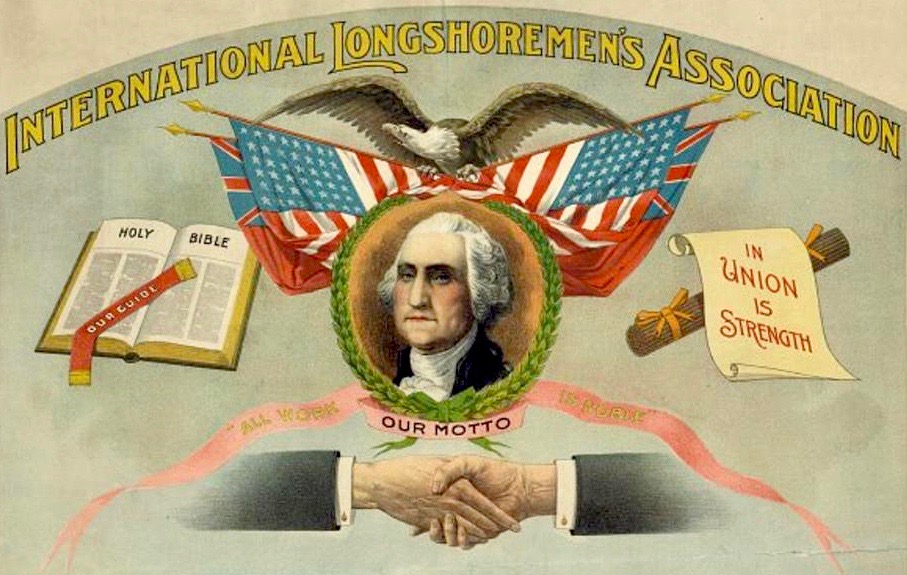
This education link has been set up to keep all ILA members informed of what’s taking place in our industry; past and present. This site will include articles, stories, photographs and videos. At times, some of the videos will include training and be educational. Other times, we will take a look into our past and learn more and more about the history of this union and how it was built into what it is today.


ILA Education/History
OFFICIAL ILA EDUCATION/HISTORY PAGE ENDORSED BY OUR INTERNATIONAL
Never forget the sacrifices ILA members made to build our great union into what it is today

Port of NY/NJ
May 27, 1949
NYC LONGSHOREMEN CREATED A LEGACY THAT HELPED BUILD OUR GREAT UNION INTO WHAT WE HAVE TODAY
By the early twentieth century the piers along the Hudson River on the West Side of Manhattan were among the busiest in the world.
From Greenwich Village north through Chelsea, ILA members were a staple in New York City and they helped shape the neighborhoods they lived in with their work ethic and dedication to the waterfront.
During this time, ILA members would often take their sons out of school and bring them to the waterfront to work on the docks to help with the family expenses at home.
The work was brutal and uncertain. Men gathered each morning for the shape up, standing in a half circle while a hiring boss picked who would work that day, and those left over went home with nothing. Longshoremen unloaded cargo by hand with iron hooks, in all weathers, for wages that rose and fell with every ship.
When the great Chelsea Piers opened in 1910 to take the largest ocean liners of the day, the waterfront moved north with them. For generations afterwards. neighborhoods on the West Side were built around the docks, the union hall and the church.
The NYC Longshoremen were extremely pivotal in building our great union into what we have today.
In photograph:
ILA Longshoremen work on Manhattan’s West Side Piers during the spring of 1949.
Joey Daggett Int'l Longshoremen's Local 1804-1
#InternationalLongshoremensAssociation

0 CommentsComment on Facebook
Port of NY/NJ
1956
THE ILA AND THE HISTORY OF SEALAND
The original SeaLand was founded by Malcolm McLean, an American trucking entrepreneur from the South who revolutionized the shipping industry by packing goods into containers, which can be transported quickly from place to place.
On April 26, 1956, the world’s first container ship, the Ideal X, sailed from Newark, NJ to Houston, TX with 58 containers on its deck.
In 1999, Maersk Line bought SeaLand and it is now known as one of the largest container shipping lines in the world.
ILA International President Harold J. Daggett began his career in the ILA in 1967 at SeaLand and remained there until he became a delegate for ILA Local 1804-1 in 1980.
ILA International President Harold J. Daggett recently shared his memories of working at SeaLand on the docks and as a delegate:
“The original cranes were built on the container ship. They were modified from oil tankers to container ships.
As SeaLand grew at Port of NY/NJ, and when cranes were put out on the land, the ILA demanded that all cranes that were built on the terminals were under the jurisdiction of the ILA and it remains that way until this day.”
We are the International Longshoremen’s Association
Established 1892
(Click on the link below for more information on the history of SeaLand)
www.mgar.net/sealand2.htm
Int'l Longshoremen's ILA South Atlantic and Gulf Coast District Local 1804-1
#InternationalLongshoremensAssociation

10 CommentsComment on Facebook
could that be one of the original “reefers”
Believe that is me in the lower right corner of this picture. (With tie).
it's not new York but ECT Rotterdam Beatrixhaven. the trucks are Scania with a cabin from a coachbuilder. ECT still operatioal as Europe combined terminals part of Hutchinson ports
Crazy, how much bigger everything has gotten since then?
De datum is fout helaas kijk het maar na het was rond 1968.
Bonita foto !!!
Never forget the Marines who gave their lives to free the crew of the Mayaquez.
REVOLUCIONARIO
Go Union
Scab/Rat papers on my FB Andy Serge
Port of Auckland
New Zealand
WORLDWIDE DOCKWORKERS MOVEMENT CONTINUES TO GROW THROUGH SPORT AT THE 10TH ANNUAL WAR ON THE WHARVES EVENT IN NEW ZEALAND
The International Longshoremen’s Association could not be any more proud to be part of the remarkable solidarity that took place in New Zealand at the 10th Annual War on the Wharves event this past week.
The ILA was well represented by ILA Local 1804-1 Business Agent/ITF Representative Billy Hartigan and 1804-1 member Tomo Popovic at this incredible event that welcomes dockworkers from countries all around the world.
This was the 10th War on the Wharves and it was the first time that the ILA participated. Every single fighter was a warrior.
The “Main Event” featured the ILA’s very own Tomo Popovic against Australian Troy Thomas of the Maritime Union of Australia.
The Maritime Union of New Zealand did an incredible job hosting and organizing the event.
ILA Local 1804-1 Business Agent Billy Hartigan shared this message to us from overseas:
“The respect that you could feel that these fighters and groups had for one another is special. Nothing like it. There’s a level of courage that people just give to each other in and out of the ring.
We are all dockworkers and the solidarity is amazing!”
The International Dockworkers Movement continues to grow as all the unions that were in attendance in New Zealand that work on the waterfront are members of the International Dockworkers Council, which is 160,000 strong, worldwide!
The IDC General Assembly will take place in Rio de Janeiro, Brazil, November, 2026.
Thank you Brother Hartigan for sharing these incredible photographs to us!
#InternationalLongshoremensAssociation


7 CommentsComment on Facebook
Love this!!! Would love to attend one
ILA. Remember to always stay safe with whatever we do. 🤟👍👍🙏
That is awesome!!
Great work, Guy’s!! Way to represent!!
Awesome! I’ll make it to the next one.
Awesome brothers stand strong
Way to go my brothers
Humble, Texas
ILA LOCALS 24, 28, 1351, 1438 AND 1530 OF THE HOUSTON DOCK AND MARINE COUNCIL COME TOGETHER AND RAISED $50,000 FOR CHARITY AT THEIR ANNUAL GOLF OUTING
Shared to us by the ILA South Atlantic and Gulf Coast District:
Congratulations to the ILA Houston Dock & Marine Council on another successful Charity Golf Tournament! ⛳️
The tournament took place at Tour 18 in Humble, TX on October 13, 2026, and thanks to the generous support of sponsors and everyone who participated, a check for $25,000 EACH was presented to BakerRipley and Cure Sanfilippo Foundation.
A special thank you to the sponsors who continue to step up and support this event year after year. Your generosity is what makes it possible!
We’re proud of our HDMC locals (ILA Locals 24, 28, 1351, 1438 and 1530) for their continued efforts to give back to the community. Great job to everyone involved!
Thank you Lauren Cloud, ILA SAGCD for contributing to this story and sharing this information with us.
#InternationalLongshoremensAssociation


2 CommentsComment on Facebook
Go Union
Port of Philadelphia
ILA FRONT AND CENTER AT THE ANNOUNCEMENT OF PHILADELPHIA PORT EXPANSION
PHILADELPHIA GOVERNOR JOSH SHAPIRO ANNOUNCED 6,000 NEW JOBS WILL BE UNION MEMBERS
Two new ship berths and a 152-acre former Navy site on the South Philadelphia waterfront are part of an $837 million expansion of the Port of Philadelphia.
State officials say the work will add 6,000 union jobs and about $45 million a year in tax revenue.
Gov. Josh Shapiro announced the plan on Tuesday, October 13, 2026, at the Southport Auto Terminal at the Navy Yard.
Philadelphia Mayor Cherelle Parker, Maritime Executives, Teamsters and ILA Longshoremen’s union leaders were in attendance.
The Port of Philadelphia supports more than 8,000 jobs now. Governor Shapiro said the expansion would lift that number to 14,000, and more importantly, he described them as union jobs.
PhilaPort CEO Rich Lazer said construction will start once permitting and contracting terms are set. He said ground should be broken in early 2027.
In photograph, left to right:
-Craig Slattery, ILA Local 1291 Business Agent
-David Saunders, ILA Local 1291 Business Agent
-Maurice Mulgrew, ILA Local 1291 Secretary Treasurer.
#InternationalLongshoremensAssociation

12 CommentsComment on Facebook
I would love to help with any transportation with the new construction and any other logistics needs! Can anyone help put me in contact with the person in charge please!
The ILA in Philly is a great group! I have had the pleasure of working with them recently. One thing I will say they have one tough battle in the city of brotherly love! From an employer that has no respect for the ILA and is double breasted, to other unions doing ILA jurisdiction work! My hat goes off to them, their battle is not easy but it is everyones battle in the ILA! Keep on keeping on Philly ILA, nothing but love for you!
Looking good 👍I.L.A. Strong💪👏
#1291
👏👏👏
Where can i apply for any cdl position
How can I apply?
Thank trump
#1694 Wilmington Delaware
Big blessing kingz
The taxpayer funded portion will be borrowed. No details on lease agreements to determine how much of spending will have meaningful public return or just making private terminal operations commercially attractive. $28 million in non itemized taxpayer spending. All because the port of Philadelphia is just not commercially attractive to bring in private investment on its own. The navigation depth is too shallow, travel inland is greater than other ports, and bridges over the Delaware River create limitations. Add the fact that Glovis specializes in finished foreign made cars, a market that will be shrinking by intentional trade policy. This is a classic example of how taxpayer money is wasted in an attempt to bend the free market. The jobs will likely never materialize, the state revenue will never reach projections and the taxpayers will be saddled with debt years after Shapiro leaves office.
Port of Auckland
New Zealand
ILA’S HARTIGAN AND POPOVIC VISIT PORT OF AUCKLAND, NEW ZEALAND; PARTICIPATES IN WAR ON WHARVES WITH DOCKWORKER UNIONS FROM AROUND THE WORLD
ILA Local 1804-1 Business Agent/ITF Representative Billy Hartigan is join by Local 1804-1 member Tomo Popovic as they, along with other dockworker unions from every corner of the globe, participate in the War on the Wharves in New Zealand.
In photograph, Business Agent Billy Hartigan and Brother Tomo Popovic visit The Port of Auckland.
—————————————————————
WHAT IS WAR ON THE WHARVES?
In War on the Wharves, sport can be understood as a powerful way for dockworkers to build solidarity, strengthen relationships, and bring together working people from different ports and countries. Beyond the competition itself, sport creates a common ground where longshoremen can connect through mutual respect, teamwork, and a shared identity as waterfront workers.
For dockworkers, solidarity is built not only on the job or through union struggles, but also through the friendships and bonds formed away from the docks. When workers come together on the playing field, they learn to trust one another, celebrate each other’s achievements, and recognize that, despite differences in language, nationality, or culture, they share many of the same values and challenges.
A real example of this is the War on the Wharves charity boxing competition, which has brought together maritime union members from Australia, New Zealand, and the United States, including ILA Local 1804-1 out of the Port of NY/NJ and ILWU Local 142 in Hawaii.
Since 2014, these events have used boxing to build relationships between dockworkers while raising money for charitable causes.
Ultimately, War on the Wharves shows that solidarity is more than a slogan. It is built through shared experiences, mutual respect, and a willingness to stand beside one another. Whether dockworkers are working the same wharf, competing in the ring, or supporting a fellow union brother or sister across the ocean, sport reminds us that we may come from different ports, but we belong to one worldwide waterfront family.
The Worldwide Dockworkers Movement has never been stronger!
#InternationalLongshoremensAssociation


6 CommentsComment on Facebook
التضامن شي جميل في حياتي عندما تكونوا متوحدون تكونون أقوى
Much respect from MUNZ Local 10 Port Chalmers. Thank you for coming over to NZ🙏🏻
Solidarity!
In solidarity from MUNZ veterans ! ⚓️
🥊🥊🥊
Port of NY/NJ
ILA LOCAL 1814
PORT LIBERTY CONTAINER TERMINAL
STATEN ISLAND, NY
ILA Local 1814 mechanics work together to keep equipment up and running during a couple of months of heavy volume that moved through Port Liberty Container Terminal in Staten Island, NY.
———————————————————————
In photograph, left to right, are ILA Local 1814 members:
Tommy Pugliese (Foreman)
Francesco Dato
Junior Poncio
Kenny Boos
Antonio Agosta
Joey Aichoun (Asst. Foreman)
Pete Sodano (Maintenance Shop Steward)
Brian Reynolds
Hipolito Pitre
Jose Matos
Alex Cubero
Thank you Pete Sodano, Maintenance Shop Steward, ILA Local 1814, for forwarding this to us!!
#InternationalLongshoremensAssociation

13 CommentsComment on Facebook
That’s the crew right there 💪💪
Great guys
Great group of guys right there !!
Thanks for your hard work!! Impressive sign you have up there!
ILA strong 🤟🙏
Great men in this photo 💪🏼⚓️🇺🇸
Go ILA STICK TOGETHER
Good crew Pete.
The best 💪💪🇱🇷
Awesome crew
The best💪🏼
The Best ILA STRONG 💪 🇺🇸💪
Go Union
Port of Virginia
Hampton Roads
A message shared to us by ILA Chief of Staff James McNamara:
**WOMEN OF THE ILA**
**KIM BROWN**
Kim Brown, ILA 1248 Member, Receives Inaugural “Thomas M. Little Annual Safety and Productivity Award” from the Port of Virginia
NORFOLK, VA. - Congratulations to the ILA’s Kim Brown, a longtime member of ILA Local 1248 in the Port of Hampton Roads, Virginia, who was recently honored by the Port of Virginia with the “Thoams M. Little Annual Safety and Productivity Award.” The Award is named for the now retired International Vice President Thoams Little who was at the ceremony to present the plaque to Sister Brown.
In addition to Thomas Little and his wife, Glenda, other ILA members participating in the ceremony included Alex Sari; Cory Tomlinson; Kyle Wallace; Jerry Kizer; Vernon Brown; Lawson Basnight; Thornton Walker and Shawn Joyner.
“I am grateful to be the first recipient of the Thomas M. Little Safety and Productivity Award,” said Kim Brown. “It’s a special thrill for me to receive an honor named for my friend and colleague Thomas Little.
The ceremony recognized Mr. Little for his five decades of leadership and commitment to safety that inspired the creation of the award.
#InternationalLongshoremensAssociation


74 CommentsComment on Facebook
Congratulations, Ms. Kim!
Congratulations my Sister!
My Girl! Congratulations Kim.💋
A Real Trailblazer for Us on this Waterfront!
Congratulations Kim!!
Congratulations 🎉
Congratulation
Congratulations Kim! Well deserved!
Congrats
God In Heaven Knows You Truly Deserve This Award. I Have Watched You Through the Years,Your Dedication and Contributions to This Organization Has Been Far Above Most. I Truly Salute You. Well Deserved !!
Congratulations you deserve it 💕💕
💪🏾💪🏾💪🏾
🫡👏🏽
👏🏾👏🏾👏🏾👏🏾
🫡💪🏾🫶🏼
Congratulations Ms. Kim 👏🏽👏🏽👏🏽
Congratulations
Congratulations 🎊
Port of Auckland, New Zealand
The International Dockworkers Worldwide Solidarity has never been stronger!!
Dockworkers from around the world take time out to visit the Port of Auckland as they participate in the War on the Wharves!!
#InternationalLongshoremensAssociation

14 CommentsComment on Facebook
Hey. From London gateway. 👍🤛
Estivadores
The kid, local 333
Solidarity Comrades
Stay strong for the future
Saludos hermanos desde el Puerto del Callao en el Perú líder Portuario de América del Sur
🖐🏽
Helloooooo from Local 21—25 & 26
Go Union
The boyz!🤙🏽🤙🏽🤙🏽
Wow nice
Weak Scab Canadian🤡 Brothers ….Stabbing A Union “Soldier” in the back 🥲 www.facebook.com/share/v/1F4o9dGR7g/?mibextid=wwXIfr
valachi papers Now released!!! www.facebook.com/share/p/1G3GWpiHjj/?mibextid=wwXIfr
Are you guys Scabs and Rats like @ilwulocal502? The Ilwu local 502 🐀 list Richard Bennet-Ratted Jesse Kormanack for killing union brother “Crackhead Brian Kearns” Brian had been living with Jesse and to feed his crack habit he was stealing from Jessie so Jessie shot him dead”Rick then turned Jesse in to rcmp. What happened to don’t harm your brother? Rolly “the rat”Hurtubuise-Rolly the rat is/was a multi time elected B/A@ 502.Ratting out current BA “at the time.”Rocky cracky Thompson” Calling rcmp and getting Rocky charged at a local bar for a personal matter.This cost the union local 10’s of thousands of dollars in lawyers fees as Rocky had a restraining order placed against him and could no longer do his current job as BA. Mike cracker Roberge “The 3 daughter father”Who burned a prostitutes body,”SHE was somebody’s daughter too!”He proceeded to call police and write paperwork on his accomplice!wtf.This was encouraged and even leveraged against him by “Uncle”Gordie Fraser”One of 502’s biggest drug distributions.Really?AYFKM Then there’s one of the biggest RATS of them all Vincent “Pickton” McMurchy.Not only is he a star in the book “on the farm”Ayfkm!He has written paperwork and ratted multiple times I have the proof it will be posted. Ratted me out called RCMP:I have paper work lol even Ald said “someone called”Ayfkm? I ended up being charged for 25lbs of weed not mine.But all the Surrey G’s got out of there before the RCMP came flying in and took me down at gunpoint not the first time lol I have the paperwork and will be Posting My Question is?Who’s the real rats? “Enemies within” 👍🏻
Port of NY/NJ
1980
ILA LEADERS COME TOGETHER FOR UNION MEETING IN NYC, 1980
ILA International President Thomas “Teddy” Gleason (center of photograph) attends membership meeting with ILA leaders in New York City, 1980.
Of course, it was unknown at the time but, the man on the far left would go on to become the ILA International President in 2011.
That man is Harold J. Daggett.
In photograph, left to right:
-Harold J. Daggett, ILA Local 1804-1 Secretary Treasurer
-Walter Sullivan, ILA International Secretary Treasurer
-Thomas “Teddy” Gleason, ILA International President
-Sonny Kenny, ILA Local 1804-1 President
-Tommy Fargin, ILA Local 1804-1 Vice President
We are the International longshoremen’s Association
Established 1892
#InternationalLongshoremensAssociation

11 CommentsComment on Facebook
The big guy is still the Big Guy!
That's the leadership I started with...good old days...great picture...could talk to Sonny about soccer all day...lol...good old days....Mark S.
Harold what a few years does to us! They were the good old days
I was very young and remember Harold back in those days!! Time sure is flying by us!! Love ❤️ my ILA family!!
Beautiful picture. Good old days
Yes they were the best days back then Harold I love that tie thank you for being you what you did for the Ila for our brothers and sisters Ila all the way
I will never forget Tommy Fargin what a great man
Great photo they certainly were good days
I will always love Sonny Rest in Peace old friend.
Go Union