
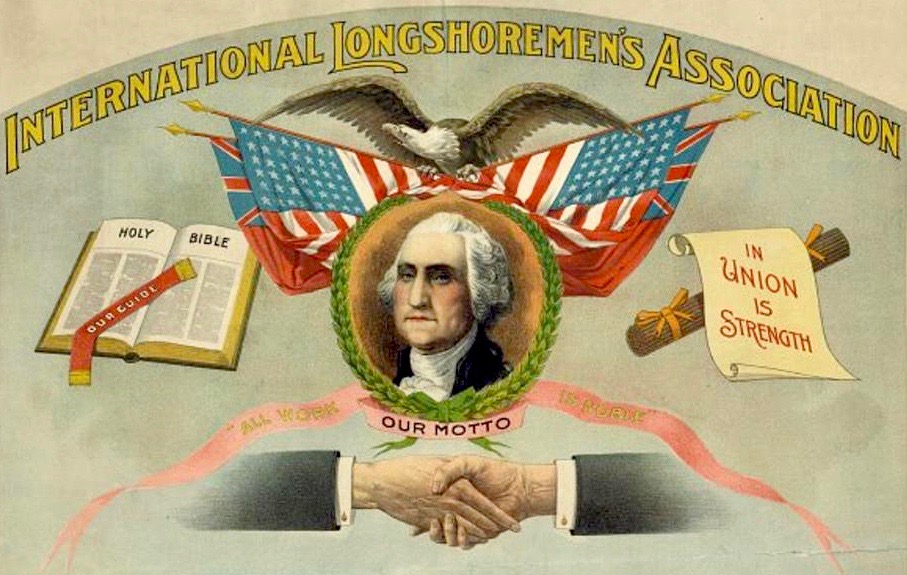
This education link has been set up to keep all ILA members informed of what’s taking place in our industry; past and present. This site will include articles, stories, photographs and videos. At times, some of the videos will include training and be educational. Other times, we will take a look into our past and learn more and more about the history of this union and how it was built into what it is today.


ILA Education/History
OFFICIAL ILA EDUCATION/HISTORY PAGE ENDORSED BY OUR INTERNATIONAL
Never forget the sacrifices ILA members made to build our great union into what it is today

Port of Charleston
Have a great weekend ILA sisters and brothers!!
Stay safe and may God Bless you and your families!!
—————————————————————
On this Saturday, October 24, 2026, we highlight the Port of Charleston.
Our ILA sisters and brothers are never short on facing challenges at the Port of Charleston in the state of South Carolina as they live and work in one of the least friendly states for labor and workers rights in the United States.
We are the International longshoremen’s Association. We are 85,000 strong.
Established 1892
—————————————————————
Our amazing ILA leadership at the Port of Charleston:
-Kenny Riley, President, ILA Local 1422, Deep Sea Longshore, ILA International Vice President
-Leonard Bailey, President, ILA Local 1422A, Maintenance and Repair, ILA International Vice President
-Lance McLaughlin, President, ILA Local 1771, Clerks and Checkers, ILA South Atlantic and Gulf Coast District Vice President
#InternationalLongshoremensAssociation

9 CommentsComment on Facebook
If you zoom in you can see Hugh Leatherman Terminal that sits empty
Thank You. ILA = I LOVE AMERICA!!! 🇺🇸❤️
Thank you!! God bless the ILA and God bless the Port of Charleston!! ILA Strong!!💪🏾💪🏾
ILA Strong!!! #ifwearetogetheritsimpossibletofail
Great job everyone.
The new year is going to bring lots of changes. Things are looking up💪🏾💪🏾💪🏾
Local 1422 ILA P21 Tamp Peace and Love !!!
Let me know when y’all put a list back up!
South Carolina State leadership will let the HLT Terminal rot and fall in the river before they let the ILA have control of the jobs at that terminal and remember state money built that terminal so it's the people of SC terminal
Port of Saint John
SOLIDARITY WITH ILA LOCAL 273 — NO PORT WORKER STANDS ALONE!
The IDC stands shoulder to shoulder with ILA Local 273 in its fight for a fair collective labour agreement at the Port of Saint John, Canada.
More than 50 days at the negotiating table. 15 days of federal mediation. And still, no agreement.
Our message to the employers is clear: workers will not move backwards. Their rights, their dignity and the sacrifices of previous generations are not bargaining chips.
Collective bargaining requires respect, fairness and a genuine willingness to reach an agreement. You cannot demand sacrifices from workers while ignoring the value of their labour.
To our brothers and sisters of ILA Local 273: you have the full solidarity and support of the IDC family.
ILA LOCAL 273, YOU ARE NOT ALONE.
AN INJURY TO ONE IS AN INJURY TO ALL.
INTERNATIONAL DOCKWORKERS COUNCIL (IDC)
United we stand.
If we’re together, it’s impossible to fail.
ILA Local 273 have been in negotiations since November of 2025 with the Port of Saint John Employers Association , DPWorld, Logistec Stevedores and Quebec Stevedores.
We have meet over 50 days and on the Unions request Federal Mediators have been participating over the last 15 days. Unfortunately the mediation process has run its course without renewal of an agreement. On October 20 ILA Local 273 applied to the Minister of Employment and Social Development Canada to appoint Federal Conciliator’s to try to move things along at a quicker pace to achieve a fair Collective Labour Agreement for its members. Once Federal Conciliators are appointed then the timeframes are in place for further job action should an agreement not be in achieved.
Your negotiating committee is working hard at the table, but are not going to agree to the unrealistic proposals from greedy employers. Some gains have been made by both sides, but the employers are going to have to have a change in course if they want an agreement. ILA Local 273 will not go backwards and lose what our forefathers fought so hard to get us to where we are today. We urge all who can attend the November monthly union meeting to attend once a date has been set.

20 CommentsComment on Facebook
Solidarité du 375 Débardeur Port de Montréal 💪
Solidarity from 1804-1
Automate it
Solidarity brothers and sistes. 💪
Solidarity for life I’m from local 13 in San Pedro, California 👌😎
I think the learn the lesson!! Let the ILA Provide the Best labor of the word and keep America Moving!! Blessings
Solidarity. All unions representing each other.
Stand together MUA
We are with you!!!
✊✊✊
Solidarity brothers and sisters 💪🏻
The only sucks thing is that union workers don’t respect truckers, they don’t care how many hours truckers wait to get one container at the port. Can’t agree with the statement that they are hard working people.
It's hard to have sympathy for them when I'm sending 2 to 3 hours waiting to get loaded or unloaded
Solidarity ILWU West Coast local 52 marine clerks
I've camera right on port
Solidarity brothers and sisters
ILA needs to tell everyone that the port operator is foreign owned by the government of Dubai that goes by the name of Port and Free Zone World Canada you must protect your sovereignty and take back such incredibly important work just for your own independence
Fire them.all!!!!!!! Have new hires ready and wai t in soon as contract expires send in new hires
Trafficking our children through there
Port of NY/NJ
ILA LOCAL 1233 LOOKS FORWARD TO CELEBRATING 100 YEARS SINCE THEIR CHARTER WAS GRANTED AS MEMBERS OF THE INTERNATIONAL LONGSHOREMEN’S ASSOCIATION ON MARCH 1, 2027
ILA Local 1233 has a long, storied history on the docks at the Port of NY/NJ.
They are part of the Longshore craft and were established on March 1, 1927.
Next year, the members of ILA Local 1233 will come together and proudly celebrate their 100th Anniversary!
#InternationalLongshoremensAssociation

15 CommentsComment on Facebook
Congratulations ✊💪🙏👏👏👏
Yo what's up ila from a different union over here United we stand💪🏻
Way to go ILA. 💪all the way . The best. .
Happy 100th Anniversary ILA
🙌🏼🙌🏼🙌🏼
💎⚓️💎
Congratulations! 🎉
ILA 1740 P.R
We get our food and our goods from all over the world international The best. 
Congratulations 🎉🎉🎉🎉👏👏👏👏👏👏
Go ILA Local 1233🎉🤟🙏
Go Union
Port Houston
October 1939
SAFETY FIRST AT PORT HOUSTON
Longshoremen guiding a compressed bale of cotton onto a hand truck in Compress, Houston, Texas sometime in October, 1939.
On the waterfront, references to a “compress” in Houston, Texas, trace back to the city’s historical role in the cotton industry, where cotton compresses were large industrial facilities used to tightly compact loose bales of raw cotton down to roughly half their original size.
#InternationalLongshoremensAssociation

3 CommentsComment on Facebook
Go Union
Andy Serge go see Harry Bridges Would Roll Over In His Grave
b4 the rat n scabs of ilw-me 502
Have you ever been in a crane this high up before?
Longshoremen move the world’s cargo from this view at ILA ports on a daily basis.
We are the International Longshoremen’s Association. Established 1892.
Maine to Texas, the Great Lakes, Puerto Rico, Eastern Canada and the Bahamas.
Check out this amazing photograph way up high in the cranes.
Photo Credit:
Jeff Williams
Hamilton, Ontario
Thank You!!
#InternationalLongshoremensAssociation

49 CommentsComment on Facebook
Proud of cousin Donnie Ange for doing so well in the crane years ago💕
Yes
Yessir I operated a dock gantry for many years on the west coast, ILWU502
Very impressive, indeed 😊😊😊
Yes
Yep. Piece of cake.
I have never seen the windows that clean though. Before. Maybe the day they were new
Pensioner ILWU local 13 port of Los Angeles Long Beach crane operator 26 years 🪝
Yes local 502 Ilwu
No, just 5 high. Highest respect for those Crane Operators.
Someone has to clean up the machine house… ha ha
The only time my heart skip a beat up there was when we were discharging. Twin picking two 20's all the way offshore in the bottom of the hole.
Yes sir I have Also seen the pope and president land together in Newark air port some years ago from up there snipers on all the roof tops no doubt we were also being watched there
Yes ILWU LOCAL 500
Worked the ports for years down here ...dispatch and repair...but I've never been off the ground
Not only have I been in a crane that high….Ive operated that exact crane. lol
Oh yes😉
Once or twice
Everyday
Yes retired ILWU Crane Operator . 😸
Yes, I worked out all the refineries in the bay area climbing up to the top welding pipe fitting. Yep done that been there.
Yes taller I drove Tallest gantry crane in world Deltaport Canada
Yes, that is in Halifax Nova Scotia.
Port Miami
Mediterranean Shipping Company (MSC) at Port Miami
Amazing evening photograph where all the lights are shining bright at MSC Cruise Terminal at Port Miami.
MSC Cruises, one of the world’s largest cruise operators, is known for its innovative ships and premium travel experiences. The MSC Miami Terminal at PortMiami, the largest cruise ship terminal in the world, was designed as both a tech-forward hub for passengers and a bold architectural landmark. Positioned on Biscayne Bay, the terminal is a showcase of Miami’s modern skyline and a gateway to the Caribbean and beyond.
The International Longshoremen’s Association helped move over 8.5 million cruise passengers at Port Miami during the fiscal year 2025.
#InternationalLongshoremensAssociation

0 CommentsComment on Facebook
Port of NY/NJ
May 27, 1949
NYC LONGSHOREMEN CREATED A LEGACY THAT HELPED BUILD OUR GREAT UNION INTO WHAT WE HAVE TODAY
By the early twentieth century the piers along the Hudson River on the West Side of Manhattan were among the busiest in the world.
From Greenwich Village north through Chelsea, ILA members were a staple in New York City and they helped shape the neighborhoods they lived in with their work ethic and dedication to the waterfront.
During this time, ILA members would often take their sons out of school and bring them to the waterfront to work on the docks to help with the family expenses at home.
The work was brutal and uncertain. Men gathered each morning for the shape up, standing in a half circle while a hiring boss picked who would work that day, and those left over went home with nothing. Longshoremen unloaded cargo by hand with iron hooks, in all weathers, for wages that rose and fell with every ship.
When the great Chelsea Piers opened in 1910 to take the largest ocean liners of the day, the waterfront moved north with them. For generations afterwards. neighborhoods on the West Side were built around the docks, the union hall and the church.
The NYC Longshoremen were extremely pivotal in building our great union into what we have today.
In photograph:
ILA Longshoremen work on Manhattan’s West Side Piers during the spring of 1949.
Joey Daggett Int'l Longshoremen's Local 1804-1
#InternationalLongshoremensAssociation

2 CommentsComment on Facebook
Back in the day the Hudson River was called North river by the longshoremen
When the Ships we we Made of Wood & The Men Were made of Steel☘️🇺🇸
Port of NY/NJ
1956
THE ILA AND THE HISTORY OF SEALAND
The original SeaLand was founded by Malcolm McLean, an American trucking entrepreneur from the South who revolutionized the shipping industry by packing goods into containers, which can be transported quickly from place to place.
On April 26, 1956, the world’s first container ship, the Ideal X, sailed from Newark, NJ to Houston, TX with 58 containers on its deck.
In 1999, Maersk Line bought SeaLand and it is now known as one of the largest container shipping lines in the world.
ILA International President Harold J. Daggett began his career in the ILA in 1967 at SeaLand and remained there until he became a delegate for ILA Local 1804-1 in 1980.
ILA International President Harold J. Daggett recently shared his memories of working at SeaLand on the docks and as a delegate:
“The original cranes were built on the container ship. They were modified from oil tankers to container ships.
As SeaLand grew at Port of NY/NJ, and when cranes were put out on the land, the ILA demanded that all cranes that were built on the terminals were under the jurisdiction of the ILA and it remains that way until this day.”
We are the International Longshoremen’s Association
Established 1892
(Click on the link below for more information on the history of SeaLand)
www.mgar.net/sealand2.htm
Int'l Longshoremen's ILA South Atlantic and Gulf Coast District Local 1804-1
#InternationalLongshoremensAssociation

20 CommentsComment on Facebook
could that be one of the original “reefers”
Believe that is me in the lower right corner of this picture. (With tie).
Crazy, how much bigger everything has gotten since then?
I just delivered a speech on the Revolutionary History of the shipping container and now this comes up! Coincidence is crazy!
Never forget the Marines who gave their lives to free the crew of the Mayaquez.
The first container in the world
Looks like the Ideal X
De datum is fout helaas kijk het maar na het was rond 1968.
Bonita foto !!!
Long life containers here on the island🇦🇼🇦🇼 there is still both containers dry & reefers
En el 1958 llegaron aPR
All the containers were 35 feet
REVOLUCIONARIO
Non for them ships 🚢 left! Y especially on left.
Una maravilla
Awesome. Mahalo.
Foto's taken at Europian Container Terminus (ECT) Port of Rotterdam 1966 The shipsname is McFairland
Looks like the next contract they will be fighting to keep Automation out other countries already have it
Go Union
Scab/Rat papers on my FB Andy Serge
Port of Auckland
New Zealand
WORLDWIDE DOCKWORKERS MOVEMENT CONTINUES TO GROW THROUGH SPORT AT THE 10TH ANNUAL WAR ON THE WHARVES EVENT IN NEW ZEALAND
The International Longshoremen’s Association could not be any more proud to be part of the remarkable solidarity that took place in New Zealand at the 10th Annual War on the Wharves event this past week.
The ILA was well represented by ILA Local 1804-1 Business Agent/ITF Representative Billy Hartigan and 1804-1 member Tomo Popovic at this incredible event that welcomes dockworkers from countries all around the world.
This was the 10th War on the Wharves and it was the first time that the ILA participated. Every single fighter was a warrior.
The “Main Event” featured the ILA’s very own Tomo Popovic against Australian Troy Thomas of the Maritime Union of Australia.
The Maritime Union of New Zealand did an incredible job hosting and organizing the event.
ILA Local 1804-1 Business Agent Billy Hartigan shared this message to us from overseas:
“The respect that you could feel that these fighters and groups had for one another is special. Nothing like it. There’s a level of courage that people just give to each other in and out of the ring.
We are all dockworkers and the solidarity is amazing!”
The International Dockworkers Movement continues to grow as all the unions that were in attendance in New Zealand that work on the waterfront are members of the International Dockworkers Council, which is 160,000 strong, worldwide!
The IDC General Assembly will take place in Rio de Janeiro, Brazil, November, 2026.
Thank you Brother Hartigan for sharing these incredible photographs to us!
#InternationalLongshoremensAssociation


8 CommentsComment on Facebook
Love this!!! Would love to attend one
ILA. Remember to always stay safe with whatever we do. 🤟👍👍🙏
That is awesome!!
Great work, Guy’s!! Way to represent!!
Awesome! I’ll make it to the next one.
Awesome brothers stand strong
Battle of the docks
Way to go my brothers
Humble, Texas
ILA LOCALS 24, 28, 1351, 1438 AND 1530 OF THE HOUSTON DOCK AND MARINE COUNCIL COME TOGETHER AND RAISED $50,000 FOR CHARITY AT THEIR ANNUAL GOLF OUTING
Shared to us by the ILA South Atlantic and Gulf Coast District:
Congratulations to the ILA Houston Dock & Marine Council on another successful Charity Golf Tournament! ⛳️
The tournament took place at Tour 18 in Humble, TX on October 13, 2026, and thanks to the generous support of sponsors and everyone who participated, a check for $25,000 EACH was presented to BakerRipley and Cure Sanfilippo Foundation.
A special thank you to the sponsors who continue to step up and support this event year after year. Your generosity is what makes it possible!
We’re proud of our HDMC locals (ILA Locals 24, 28, 1351, 1438 and 1530) for their continued efforts to give back to the community. Great job to everyone involved!
Thank you Lauren Cloud, ILA SAGCD for contributing to this story and sharing this information with us.
#InternationalLongshoremensAssociation


2 CommentsComment on Facebook
Go Union